Showing posts with label dyslexia. Show all posts

Thursday, November 17, 2011

Can You Feel the Writing?

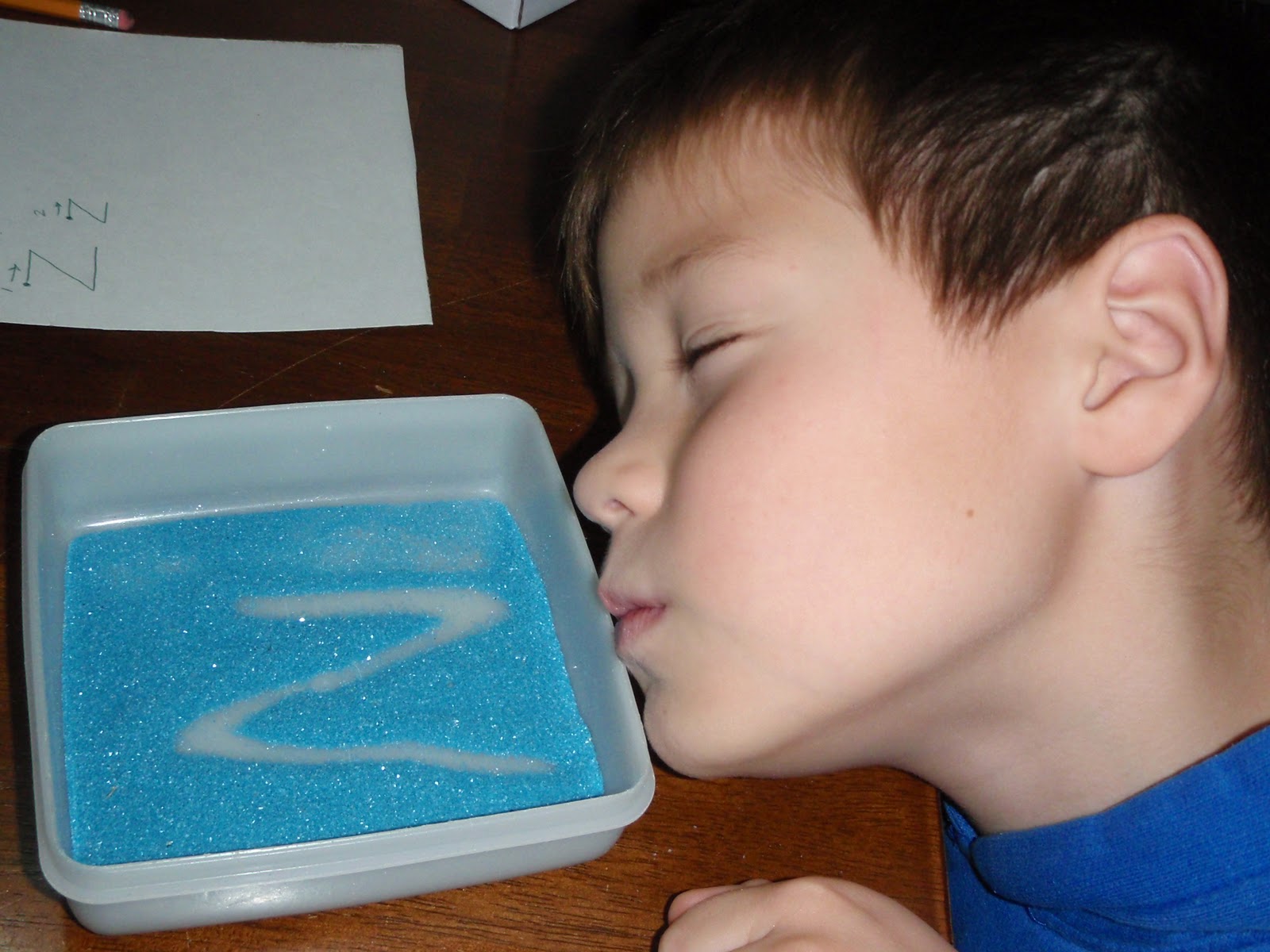
I have used a small sand box for several years to teach my children to form letters and numbers.  I stopped using this for my seven year old because I figured that he already knew them all and he just needed to practice writing.  Well, I was wrong.  He still needs to "get the feel" of how to write the right way!  
(The Anchor is a lefty)
 Writing in sand is multi-sensory which gives your brain more ways to remember and connect information.  You can feel, see, and even hear the letters forming.  With a pencil, there is an inanimate object between your hand and the actual letter you are writing.  While it is important for kids to master writing with a utensil, they need to first understand what the letter should look like.  
(Pretending to be asleep and snoring, "ZZzzzz")
As I have written in past posts, my seven year old can hardly tell the difference between any letter or number that is written correctly, backwards, or even upside down.  So I've brought out the sand box for him again.  I have him draw "trouble" letters and numbers over, and over, and over again.  For him, it's fun, and much easier than trying to wield a pen or pencil.  He's also getting a sense of how the letter "feels" which is making it a lot easier for him to transfer that information to a paper and pencil.  This year I have a small Tupperware with a thin layer of colored sand for each child.  I usually color code my boys so The Free One gets blue and The Anchor gets green.  You can buy the sand at almost any craft store, or online at www.orientaltrading.com.  You can even get glow in the dark sand from them.  Now how fun would that be?  

Saturday, November 5, 2011

Want To Read Better? Do Jumping Jacks.

I'd like to introduce you to a couple of "P.E. for two" activities that we use in our home school that just may be helping with reading and writing abilities as well as physical abilities.
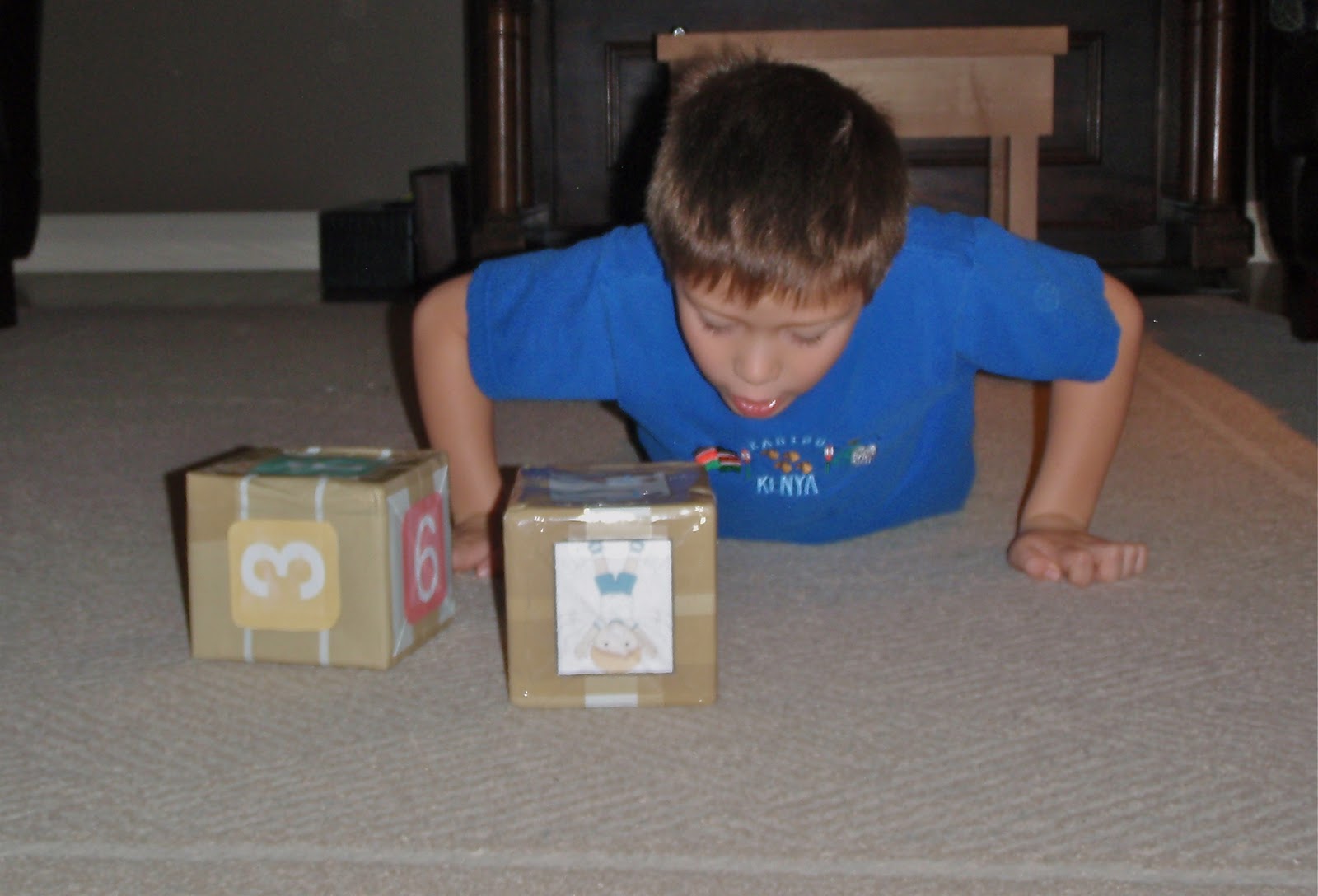
1.  FITNESS DICE:  I covered small square cardboard boxes for the dice.  Then I glued the numbers 1-6 onto one and pictures of exercises on the other.  (jumping jacks, windmills, push ups, sit ups, lunges, and running in place.)  I did google searches to find the numbers and the pictures of the exercises, but you could just as easily draw the numbers and pictures onto the dice.  My kids take turns rolling the dice and they both do the exercises.  I set the timer for however long I want them to exercise.

Above:  5 Push Ups
Left:  Running in Place for 2 minutes


Jumping jacks and lunges.  


2.  YOGA KIDS:  My sister bought these DVDs for us a couple of years ago.  They are very fun and the boys enjoy challenging themselves with all the fun stretches and poses.  Click on the picture below to go to their website where you can purchase the DVDs and browse more options.  The ages say up to 6 years old, but my oldest who is seven loves it and I can see us using these for at least a couple more years.

YogaKids 2 and 3 Pack - DVD

I have noticed that when my oldest son has had some physical exercise before school he is more successful in his work.  He can focus and concentrate better, he has a more positive attitude toward his work, he accomplishes tasks faster, and stays on task better.  So I was not surprised to find a whole chapter in the Day-to-Day Dyslexia book by Pollock, Waller, and Politt devoted to movement and exercise.  

Here are a few quotes from the book:

"It has been proved that movement in the form of exercises can help children to learn...  New research is constantly being carried out to consider ways in which physical exercise can help dyslexic children and adults on a day-to-day basis."  p. 41

"Now it is realized that exercises that mimic the natural development of babies and toddlers are very important and enable not only children, but also adults, to acquire literacy and numeracy techniques much more rapidly."  p. 44

The chapter gives several suggestions for daily exercises such as commando crawling, marching, touching opposite hands to knees, and making big figure eights with your hands while your eyes track the movements.  They also suggest that climbing, crawling, rolling, spinning, and balancing will also help with cognitive and motor development.  


The book also emphasizes the need for children to stay hydrated with water since it improves energy and concentration.  I have also seen this to be true.  Sometimes a simple drink of water will perk my kids up when they are losing steam during school.


In light of this information:  
From now on I will lead some physical exercises before we start school and have a bottle of water at each boy's work station.




Sunday, October 30, 2011

Exploring Dyslexia

Do you know what this is?  


What about this?      


O.K. Now what is it?


If I roll it on its side is it still the same thing?


Hmmm...  interesting.  So just because I change the orientation of something it doesn't change what it is?  

Alright then...
What about these?  
b p d q 

And these?  
u n

"...a child learns that an object does not change simply because he sees it from another angle, and that a cup, for instance, remains a cup in whatever position it is placed." 
"A child may readily accept this, but then be introduced to our alphabet, in which it is imperative that each letter is always reproduced facing a particular way.  He may find it very difficult to perceive that b and d are not one and the same, and when he does understand that they are two different letters there is the problem of remembering which is which."  excerpts from Day-to-Day Dyslexia in the Classroom by Pollock, Waller, and Politt
I am now remembering how challenging it was for my son to distinguish between these tricky letters as he was learning the alphabet.  It didn't alarm me three years ago because I thought he would just get it over time.  

Well, apparently he didn't.  This why he's not enjoying reading at the level of which I know he is capable.  This is why writing practice is such a struggle for us.  This is also why I'm furiously researching ways to help with his dyslexic tendencies.  Thankfully, the information I have found is both plentiful and encouraging.  

I didn't learn much about dyslexia in grad. school.  Just a few tips and tricks I've used successfully with other students.  But, I've used every card I had up my sleeve -which were not many- and I'm in need of a bigger deck.  With a lot of prayer, patience, and desperate research, I, teacher mom, will come to the rescue!  One of first resources that I've pick up is The Day-to-Day Dyslexia in the Classroom book that I quoted from earlier.  As its name suggests, it is chock-full of practical ideas and exercises that help with dyslexia in nearly every aspect of education.  

I'll be blogging about some new things I learn.  Hopefully, they will come in handy for some other moms or teachers in need of ideas, and if you've been there and done this, please leave a comment and share your wisdom with us all.

Disclaimer:  My son has not been diagnosed with dyslexia.  I am not big on labels so I'm not intending to diagnose him.  I am simply seeing in him many of the signs and tendencies that people with with dyslexia exhibit.